Mayan Gods: Complete List of 20+ Deities & Powers
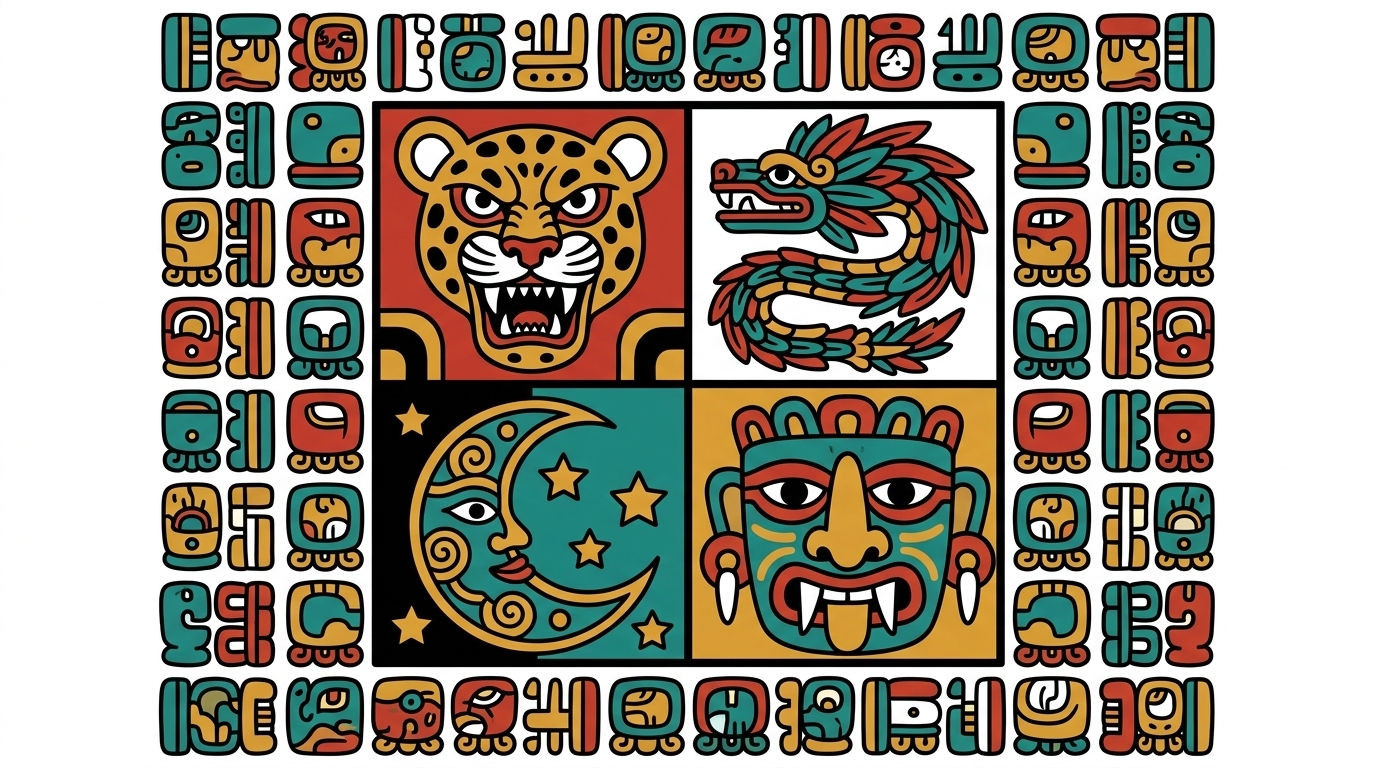
The Mayan Pantheon: A World Full of Gods
The ancient Maya did not worship one god. They worshipped hundreds.
The Mayan pantheon was one of the most complex religious systems ever developed by a human civilization. It included gods of rain, corn, death, war, the moon, the sun, the underworld, medicine, weaving, cacao, wind, and time itself. Gods came in pairs, in fours, in opposites. They shifted form, merged with each other, and appeared across dozens of regional traditions across Mexico, Guatemala, Belize, Honduras, and El Salvador.
Understanding the Mayan gods means understanding how the Maya understood the world: as an interconnected web of natural forces, each with divine personality, each requiring attention, respect, and ceremony.
The Major Mayan Gods: Quick Reference
| God | Domain | Symbol |
|---|---|---|
| Itzamná | Creation, knowledge, writing | Elderly man with hooked nose |
| Kukulkan | Wind, rain, Venus, creation | Feathered serpent |
| Ixchel | Moon, medicine, weaving | Woman with serpent headdress |
| Balam | Night, underworld, jaguar power | Jaguar |
| Chaac | Rain, thunder, lightning | Long-nosed figure with lightning axe |
| Hun Hunahpu | Maize, death, rebirth | Young man with corn cob headdress |
| Ah Puch | Death, darkness, disaster | Skeletal figure |
| Kinich Ahau | Sun | Sun disc and jaguar (night form) |
| Hunahpu & Xbalanque | Heroism, death, resurrection | Twin ballplayers |
| The Bacabs | Four cardinal directions | Four jaguar gods at world’s corners |
Itzamná: The Mayan Creator God
At the top of the Mayan pantheon stood Itzamná, the lord of the heavens, creator of all things, and patron of knowledge and writing.
Itzamná was depicted as an elderly man with a hooked nose: ancient, wise, and supreme. He was the husband of Ixchel, the moon goddess, and together they represented the fundamental duality of the universe: sun and moon, masculine and feminine, sky and earth.
Itzamná was credited with giving the Maya their writing system, the hieroglyphic script that covers the monuments at Copán, Palenque, and Tikal. He was also the patron of healers and scribes, the divine embodiment of knowledge itself.
In some traditions, Itzamná could resurrect the dead, making him the ultimate source of life and renewal.
Kukulkan: The Feathered Serpent
No deity in the Mayan world commanded more awe than Kukulkan, the Feathered Serpent, lord of wind, rain, and creation.
His name in Yucatec Maya combines k’uk’ (feather) and kaan (serpent). He was the Mayan version of Quetzalcoatl, the same divine archetype that appears across virtually every major Mesoamerican civilization, from Teotihuacan to Tula to Chichen Itza.
Kukulkan ruled over:
- Wind and storms: he breathed life into the world
- Rain and water: essential for crops in the tropical Maya world
- Venus: the morning star, tracked by Mayan astronomers with extraordinary precision
- Creation itself: he appears in the Popol Vuh as one of the gods who shaped the earth
The most famous monument to Kukulkan is El Castillo at Chichen Itza, a pyramid engineered so precisely that during the spring and fall equinoxes, sunlight creates the shadow of a serpent descending its northern staircase. This effect lasts 34 minutes and recurs every year with perfect accuracy, over 1,000 years after it was built.
We named our Kukulkan dark roast after this deity: bold, commanding, built for intensity. Dark chocolate, smoky cedar, dried cherry.
Read the full story of Kukulkan →
Ixchel: The Moon Goddess
Ixchel was the principal moon goddess of the Maya, patron of medicine, weaving, fertility, and the lunar cycle.
She existed in two forms: a young, radiant goddess associated with creation and fertility, and an old, fierce goddess who poured floods from a vessel on her head. The Maya understood that the moon, like life, contains both light and shadow.
Her primary temple was on the island of Cozumel, off the Yucatán coast. Maya women made pilgrimages across open water to reach her shrine, seeking blessings for childbirth, fertility, and healing. When Hernán Cortés arrived in Cozumel in 1519, he found the temple still active and immediately ordered it destroyed.
Ixchel’s connection to healing reflects the Maya’s sophisticated understanding of medicine. The Ritual of the Bacabs, a colonial-era text preserving ancient Mayan healing prayers, contains numerous invocations to Ixchel by healers and midwives.
Our Mut light roast carries Ixchel’s spirit: luminous, floral, alive. Jasmine, orange blossom, stone fruit, honey finish.
Read the full story of Ixchel →
Balam: The Jaguar God
In Mayan, balam means jaguar, but the jaguar was far more than an animal. It was a god, a spirit guide, and a symbol of supreme power.
Balam ruled the night, the underworld, and the hidden forces of the earth. Mayan kings wore jaguar pelts and took jaguar names as a claim of divine authority. Warriors called on Balam before battle. Shamans (balamo’ob) could take jaguar form, moving between the world of the living and the dead.
The jaguar’s nocturnal nature made it uniquely powerful in Mayan cosmology. The Maya believed the sun traveled through the underworld (Xibalba) each night, taking the form of a jaguar, the night sun. This made Balam the guardian of the cosmic dark, the protective force that ensured the sun would rise again each morning.
At Copán, where our coffee grows, the jaguar appears everywhere: on temple carvings, on ceremonial thrones, on the Jaguar Stairway that’s considered one of the greatest pre-Columbian artworks ever made.
Our Balam medium roast carries that balanced power: brown sugar, toasted almond, clean citrus. Bold but not overwhelming.
Read the full story of Balam →
The Mayan Snake God: Kukulkan and Serpent Worship
The serpent was one of the most powerful symbols in the Mayan world, and the greatest of all Mayan snake gods was Kukulkan, the Feathered Serpent. Serpents represented the earth, water, and the boundary between the living world and Xibalba, the underworld. The Vision Serpent, depicted in Mayan art as a great snake rising from a bowl of burning incense, was the conduit through which kings communicated with their ancestors and the gods.
Beyond Kukulkan, serpent imagery permeated Mayan religion. The cosmic serpent carried the sky on its back. Double-headed serpent bars were held by rulers as symbols of divine authority. At Copán, serpent carvings wind through the monuments alongside jaguars and quetzal birds, forming a visual language of power that the Maya maintained for centuries.
Read the full story of Kukulkan, the Feathered Serpent →
Hunahpu and Xbalanque: The Hero Twins
One of the most beloved stories in Mayan mythology is the tale of the Hero Twins, Hunahpu and Xbalanque, preserved in the Popol Vuh, the Mayan creation epic.
The twins were extraordinary ballplayers whose skill angered the lords of Xibalba, the underworld. Summoned below, they faced a series of impossible tests (the Dark House, the Cold House, the Jaguar House, the House of Fire, the House of Bats) and survived through wit and supernatural ability.
Their story is a cosmic journey: descent into death, transformation, and resurrection. The twins ultimately became the sun and the moon, celestial bodies that die each day (setting) and are reborn each morning (rising).
The ballgame itself (pitz in Mayan) was far more than a sport. The rubber ball represented the sun; the game was a ritual re-enactment of the Hero Twins’ battle against death. The Copán ruins contain one of the best-preserved ballcourts in the Maya world.
The Popol Vuh is the single most important text of Mayan mythology. If you want to read the original stories of the Hero Twins, the creation of humanity, and the gods we’ve described here, Dennis Tedlock’s translation is the standard.

Popol Vuh: The Definitive Edition
The Mayan creation story — the Hero Twins, the gods, the origin of humanity.
Approximate price · Check current price on Amazon
Chaac: The Rain God
Chaac was the god of rain, lightning, and thunder. For a civilization dependent on agriculture in a seasonal tropical climate, this made him one of the most practically important deities in the entire pantheon.
Chaac was depicted as a long-nosed figure with scales, often holding a lightning axe. He was believed to strike clouds with this axe to produce thunder and release rain. In drought years, the Maya performed elaborate Chaac ceremonies, often lasting four days, with offerings of food, copal incense, and sometimes blood.
The famous “rain god masks” that appear on many Mayan temples (the long-nosed stone faces stacked in rows) are depictions of Chaac, prayers carved in stone, asking for water.
In the highlands of Honduras, where our coffees grow, rainfall timing is critical for coffee quality. The wet season brings the water that swells the coffee cherries; the dry season concentrates the sugars before harvest. Chaac’s cycles govern everything.
For a reference you can keep next to you while reading — Miller and Taube’s illustrated dictionary covers over 250 Mesoamerican gods and symbols.

The Gods and Symbols of Ancient Mexico and the Maya
An illustrated dictionary of every Mesoamerican deity and symbol.
Approximate price · Check current price on Amazon
The Maize God (Hun Hunahpu)
If Chaac was the most practically important deity, the Maize God, called Hun Hunahpu, was the most symbolically profound.
Corn (maize) was the foundation of Mayan civilization. The Maya believed humans were literally made from corn. In the Popol Vuh, the gods create successful humans by grinding white and yellow maize into dough. Everything else had failed: mud and wood people fell apart or burned. But corn people worked.
The Maize God was depicted as a young, beautiful man, often with a cob of corn emerging from his head. He died and was reborn, like corn that is harvested, stored, planted, and grows again, making him the deity of resurrection and agricultural renewal.
At Copán, the Maize God appears in extraordinary stone carvings that show the deity in various states of transformation. The Copán artisans were the finest sculptors in the Maya world, and their images of the Maize God are among the most beautiful pre-Columbian artworks ever found.
Ah Puch: The God of Death
Ah Puch (also called Kisin or Hun Ahau) was the lord of the lowest level of Xibalba, the Mayan underworld. He was the god of death, darkness, and disaster.
Ah Puch was depicted as a skeletal figure with bloated flesh and the smell of decay. Not a gentle death deity, but a terrifying one. He was associated with owls (whose nighttime call the Maya interpreted as a death omen) and the number ten.
But the Maya’s relationship with death was more complex than simple fear. Xibalba wasn’t entirely negative. It was necessary. The Hero Twins’ descent into Xibalba and eventual triumph over its lords was the model for human death and rebirth. The underworld was the darkness that made light meaningful.
The Bacabs: The Four World-Holders
The Bacabs were four gods who stood at the four corners of the world, holding up the sky. Each was associated with a cardinal direction and a color:
- East: Red, Chac Xib Chac
- North: White, Zac Xib Chac
- West: Black, Ek Xib Chac
- South: Yellow, Kan Xib Chac
The Bacabs were also associated with the jaguar (Balam), and each corner of the world was guarded by a jaguar god. When the Maya spoke of Balam protecting the earth, they often meant the Bacabs specifically.
Kinich Ahau: The Sun God
Kinich Ahau was the sun deity, the most visible and daily presence of the divine. He traveled across the sky each day in his canoe, bringing light and heat to the world.
At night, Kinich Ahau descended into Xibalba and became the Jaguar God of the Underworld, the night sun, traveling through darkness. This transformation made the sun and the jaguar intimately connected: both were the sun, one by day and one by night.
The Maya tracked the sun’s path with extraordinary precision. Their architecture, including El Castillo at Chichen Itza, was aligned with solar events: solstices, equinoxes, and specific sunrise and sunset points throughout the year.
The inscriptions at Copan, Palenque, and Tikal that tell these gods’ stories were unreadable until the 1970s. Breaking the Maya Code is the story of how we learned to read them.

Breaking the Maya Code
The detective story of how scholars cracked the Mayan hieroglyphs.
Approximate price · Check current price on Amazon
The Mayan Gods and Our Coffee
At Mayan Origin, we named our three private label coffees after Mayan deities because these gods are not just mythology. They’re the living heritage of the region where our coffee grows.
The Copán highlands of Honduras were the heart of Mayan civilization in Central America. The kings who built those temples, the farmers who grew cacao in those same valleys, the astronomers who calculated the movements of Venus across centuries: their descendants still live in the mountains of western Honduras and eastern Guatemala.
When you drink our coffee, you’re tasting a place with one of the deepest cultural histories in the world.
- Balam Medium Roast: the balanced power of the jaguar god. Brown sugar, toasted almond, clean citrus.
- Mut Light Roast: the luminous spirit of the sacred bird and moon goddess. Jasmine, orange blossom, stone fruit.
- Kukulkan Dark Roast: the commanding force of the feathered serpent. Dark chocolate, smoky cedar, dried cherry.
We also carry a wider selection of Honduras coffees from producers with deep roots in the region. Café Maya Coffee Club is a 100% Honduran arabica — their “Mayan Roast” — crafted by a producer with over 63 years of tradition in Honduras. Mythoz won the Global Coffee Awards 2025 and is sourced direct-trade from 109+ producer families across five Honduran regions.
For a deeper look at what the ancient Maya ate and drank alongside their sacred drinks, see our guide to Mayan civilization food.
Further Reading
If you want to go beyond this guide, these two books are where serious students of Mayan civilization start.

The Maya (9th Edition)
The most respected introduction to Mayan civilization in print.
Approximate price · Check current price on Amazon

The True History of Chocolate
How a bitter Mesoamerican drink conquered the world.
Approximate price · Check current price on Amazon
Frequently Asked Questions
How many gods did the Maya have? The Maya worshipped hundreds of deities, though the exact number is difficult to determine. The Mayan pantheon was highly regional and changed across different cities, time periods, and the 2,000+ years of Maya civilization. The Ritual of the Bacabs alone names dozens of gods.
Who was the most important Mayan god? It depends on the period and region. Itzamná was often considered the supreme creator god. Kukulkan was the most widely revered across Mesoamerica. Chaac was probably the most prayed-to in daily life, given how much the Maya depended on rain for agriculture.
Who is the Mayan creator god? Itzamná is the Mayan creator god — lord of the heavens, patron of knowledge and writing, and husband of Ixchel. He stands at the top of the Mayan pantheon as the deity who created the world, gave the Maya their hieroglyphic script, and in some traditions had the power to resurrect the dead.
What are the Mayan underworld gods? The Mayan underworld, Xibalba, was ruled by 12 death lords. The most prominent was Ah Puch (also called Kisin or Hun Ahau), depicted as a skeletal figure of decay and darkness. The other lords presided over specific forms of suffering: disease, pain, starvation, and fear. In the Popol Vuh, the Hero Twins Hunahpu and Xbalanque descend into Xibalba and ultimately defeat its lords through cunning — making their story the Maya’s central myth of death and resurrection.
Who is the Mayan god of death? Ah Puch (also known as Kisin) was the primary Mayan god of death, ruling the lowest level of Xibalba. He was depicted as a skeletal figure with bloated flesh, associated with owls, the smell of decay, and the number ten. Unlike some death deities in other traditions, Ah Puch was not a gentle figure — he represented the terrifying, unavoidable reality of death.
What is the Mayan underworld called? The Mayan underworld was called Xibalba, meaning “place of fear.” It had 12 lords and multiple levels, each more terrifying than the last. The Hero Twins descended into Xibalba and ultimately triumphed over its lords, making their story the Maya’s model for death and resurrection.
Are the Mayan gods still worshipped? Yes. Indigenous Maya communities in Guatemala, southern Mexico, Honduras, and Belize maintain living religious traditions that incorporate pre-Columbian deities alongside Catholic saints. The Q’eqchi’ Maya in Guatemala continue ceremonies honoring many of the ancient gods, particularly those connected to the corn harvest and the mountains.
What is the Mayan creation story? The Maya creation myth is told in the Popol Vuh, written down in the Kiche Maya language in the 16th century but based on oral traditions going back thousands of years. In it, the gods create the world, fail twice (with mud and wood people), and finally succeed by making humans from white and yellow maize.
Explore the Mayan highlands. Shop all our coffees from Copán, Honduras.